Learn the pros and cons of heating your Minnesota pool with solar power.
Every spring, as Minnesota pool owners calculate their heating bills from the previous season, the same question arises: "Isn't there a cheaper way to heat my pool?"
Solar pool heating seems like the perfect answer. Minnesota gets plenty of sunshine during summer months, solar technology has improved dramatically, and the fuel is free. But here's what most solar pool heating salespeople won't tell you: Minnesota's climate presents unique challenges that make solar heating far less effective than it is in warmer states.
At Plan Pools, we've researched solar heating extensively, installed systems for customers who specifically requested them, and tracked their real-world performance across the Twin Cities metro area. We're going to give you the honest truth about solar pool heating in Minnesota—both the genuine benefits and the significant limitations.
Solar pool heating systems pump water from your pool through solar collectors (typically mounted on your roof or ground-mounted on racks), where the sun heats the water before returning it to the pool. The concept is elegantly simple: free energy from the sun replaces expensive gas or electricity.
Solar collectors come in several types:
Unglazed Collectors: Made from durable rubber or plastic, these are the most common and cost-effective option. They work well in summer but have no insulation, making them ineffective in cooler temperatures.
Glazed Collectors: Feature glass covers and insulation, making them more efficient in cooler weather but significantly more expensive. They're typically used for year-round applications in warmer climates.
Evacuated Tube Collectors: The most efficient but also most expensive option, using vacuum-sealed glass tubes. Rarely cost-effective for Minnesota residential pools.
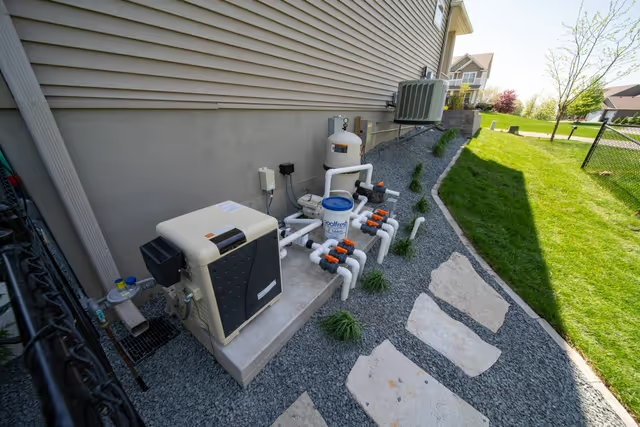
A complete solar pool heating system includes:
Installation costs for Minnesota residential pools typically range from $4,000-$8,000 for unglazed systems and $8,000-$15,000+ for glazed systems, depending on collector area, mounting complexity, and integration with existing equipment.
Peak Season Performance
During June, July, and early August—when we get long days, high sun angles, and consistently warm temperatures—solar pool heating can be remarkably effective. On a sunny summer day, a properly sized solar system can raise your pool temperature 5-10°F, which is often enough to keep a pool comfortable during peak season.
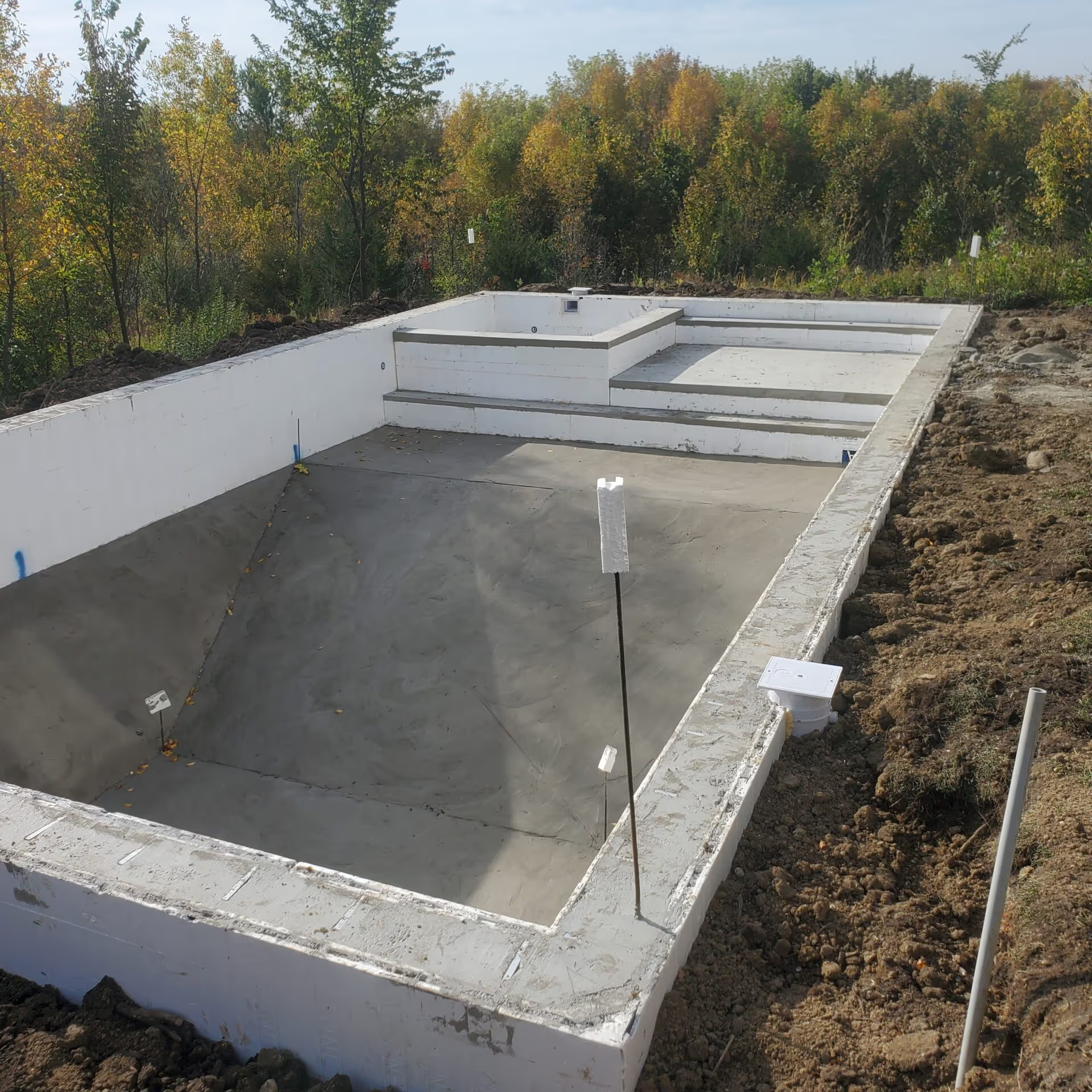
If your pool construction includes superior insulation like ICF walls from Plan Pools, the heat solar collectors generate is retained much better than with steel wall pools. This synergy between efficient heating and superior insulation can make solar heating genuinely useful during peak months.
Shoulder Season Support
In late May and early September, solar heating can extend your season by supplementing your primary heater. While it won't heat your pool from 55°F to 80°F on its own, it can help maintain comfortable temperatures once your gas or electric heater has done the heavy lifting.
Operating Cost Savings
When solar heating is working effectively during peak season, it absolutely reduces your gas or electric heating costs. The sunlight is free, and the only operating expense is a slight increase in pump runtime (typically 20-40% more electricity usage for the pump).
For ICF pool owners with already-low heating costs, solar can reduce those costs further during summer months—perhaps saving $300-$600 per season. For steel wall pool owners with astronomical heating bills, solar might save $800-$1,500 during peak months, though it still won't solve the fundamental inefficiency problem.
Limited Seasonal Effectiveness
This is the critical limitation: Minnesota's pool season extends from May through September, but solar heating only works effectively for 2-3 months of that window. In May, when water temperatures are in the 50s and 60s and you desperately want to heat your pool, solar collectors struggle because:
The same problems reappear in September, when solar heating becomes increasingly ineffective just as you're trying to squeeze the last swimming days out of the season.
Overnight Heat Loss
Solar only heats during daylight hours. Minnesota nights—even in summer—are often quite cool. If your pool loses 3-5°F overnight (typical for steel wall pools, less for ICF pools), your solar system must first recover that lost heat before it can raise the pool temperature.
With steel wall construction, overnight heat loss often equals or exceeds what solar collectors can add during the day. This creates a frustrating cycle where your pool never quite gets warm enough. With ICF construction, overnight loss is minimized, making solar supplementation more effective.
Weather Dependency
Minnesota weather is notoriously unpredictable. A string of cloudy or rainy days means zero solar heating, even in July. You'll still need backup heating capability, which means you're investing in two complete heating systems rather than one reliable primary system.
Space Requirements
Effective solar heating requires collector area equal to 50-100% of your pool's surface area. For a typical 16x32 pool (512 square feet), you need 250-500 square feet of collectors. That's a lot of roof space or ground area dedicated to equipment that only works effectively for 8-10 weeks per year.
Not all roofs are suitable for solar collectors. You need proper orientation (south, southeast, or southwest facing), appropriate pitch, structural capacity for the weight, and no shading from trees. Many Minnesota homes simply don't have adequate roof space or orientation for effective solar pool heating.
Let's use realistic numbers for a typical Twin Cities pool:
Unglazed System Installation: $5,000-$7,000Glazed System Installation: $10,000-$14,000
For ICF Pool Owners (already efficient heating):
Your annual heating costs with gas or heat pump are already modest—perhaps $1,000-$1,600 per season. Solar might reduce that by 30-40% during peak months when it's most effective, saving you $300-$600 annually.
Payback period: 10-20+ years
System lifespan: 15-20 years
The economics are marginal. By the time your solar system pays for itself, you're approaching the end of its useful life. You might save some money over the long term, but the return on investment is modest.
For Steel Wall Pool Owners (inefficient heating):
Your annual heating costs might be $2,500-$4,000 or more. Solar could potentially save $800-$1,500 annually during the months it works effectively.
Payback period: 5-10 years
System lifespan: 15-20 years
The economics are better, but here's the problem: if you have a steel wall pool with terrible heating efficiency, your real solution isn't adding solar heating—it's replacing the pool with ICF construction. Spending $7,000 on solar heating for a steel wall pool is putting a band-aid on a broken system.
Instead of spending $7,000 on a solar heating system that works for 2-3 months per year, consider what else that money could buy:
Heat Pump Upgrade: A premium heat pump with excellent efficiency costs $4,000-$6,000 and provides consistent heating all season long, regardless of weather.
Automated Pool Cover: A quality automated cover costs $8,000-$12,000 and reduces heat loss by 70-95% every single night, reduces chemical usage, and provides safety. This pays for itself much faster than solar in Minnesota conditions.
Putting It Toward ICF Construction: If you're building a new pool, the $7,000 you'd spend on solar heating could go toward the construction upgrade from steel wall to ICF, which saves 60% on heating costs year after year for decades.
We have customers who are satisfied with their solar heating systems, but they share common characteristics:
These customers report that solar heating makes their pool noticeably warmer during June, July, and early August, particularly during sunny stretches. They still use their gas or heat pump heaters in May, late August, and September, but solar reduces their overall heating costs modestly during peak season.
We've also seen installations that disappointed homeowners:
Steel Wall Pool with Solar: Customers with steel wall construction who installed solar hoping it would solve their heating cost problems discovered that the poor insulation of steel wall construction meant their pools still lost heat overnight faster than solar could replace it during the day. They ended up with an expensive system that didn't solve their fundamental problem.
Inadequate Sizing: Some homeowners installed undersized systems (trying to save money on initial investment) that simply couldn't heat their pool adequately even in perfect conditions.
Shading Issues: Collectors installed on roofs that experience afternoon shading from mature trees never performed as expected, leaving homeowners frustrated with their investment.
Maintenance Neglect: Solar collectors require occasional cleaning and system maintenance. Homeowners who neglected this found their system's performance degrading over time.
Minneapolis-St. Paul receives approximately 2,800 hours of sunshine annually—significantly less than Phoenix (3,800 hours) or Miami (3,200 hours) where solar pool heating is much more effective. Our clouds, frequent weather systems, and dramatic seasonal changes make solar heating less predictable and less reliable than in traditional "solar states."
Minnesota's sun angle varies dramatically from summer to winter. Even during pool season, the angle in May and September is much lower than July, reducing collector efficiency precisely when you need heating most.
If you're determined to include solar heating in your pool project, ICF construction makes it significantly more effective. The superior insulation means:
At Plan Pools, when customers ask about solar heating, we always recommend evaluating it in combination with ICF construction rather than as an alternative to efficient construction methods.
Set realistic expectations for when solar heating will be useful:
May: Minimal benefit. Water is too cold, sun angle is low, solar alone cannot heat the pool adequately.
June: Increasingly useful. Solar can provide significant heating during sunny periods.
July-Early August: Peak performance. Solar can maintain or slightly increase pool temperature on sunny days.
Late August-September: Declining effectiveness. Lower sun angle and cooler nights reduce solar contribution.
Solar heating is NOT a replacement for your primary heating system in Minnesota—it's a supplement that works during a relatively narrow window.
Before investing in solar heating, consider these alternatives that often provide better value in our climate:
Modern heat pump technology is dramatically more efficient than older systems. Premium heat pumps can deliver 5-6 BTUs of heat for every BTU of electricity consumed. While they're slower than gas heaters, they're much more economical to operate and work consistently regardless of sunshine.
For ICF pool owners, heat pumps are an excellent match. The insulation means you can heat the pool once and maintain temperature with modest daily runtime, making heat pump efficiency truly valuable.
If you need quick heating capability (especially for early or late season use), a modern high-efficiency gas heater with smart controls provides reliable performance. Yes, gas is expensive, but with ICF construction reducing your heating needs by 60%, gas heating becomes affordable even in Minnesota.
The most flexible approach is combining a heat pump for primary heating with a gas heater for rapid temperature recovery or cold-weather heating. This gives you efficiency when conditions allow and power when you need it, without depending on unpredictable sunshine.
The single most cost-effective heating "system" isn't a heating system at all—it's preventing heat loss. A quality automated pool cover retains heat overnight, dramatically reducing the amount of heating required.
For the investment that a solar heating system would require ($5,000-$8,000), you could install a premium automated cover that works every single night, regardless of weather, and provides safety benefits that solar collectors never will.
When customers ask us about solar pool heating, here's our honest advice:
If you're building a new pool: Invest in ICF construction first. This single decision will reduce your heating costs by 60% year-round, season after season, for decades. Then, if you still want to add solar supplemental heating after a season or two, you'll know exactly what your needs are and can make an informed decision.
If you have an existing steel wall pool: Don't add solar heating to an inefficient pool. You're spending thousands of dollars to partially solve a problem that stems from inadequate construction. Save that money toward eventually replacing your pool with ICF construction.
If you have an ICF pool and want to maximize efficiency: Solar can be a reasonable addition, but compare it carefully to heat pump upgrades, automated covers, and other improvements that might provide better year-round value.
Solar pool heating works, but it works best in climates with long, consistent sunny periods and warm overnight temperatures—neither of which describes Minnesota. It can provide meaningful supplemental heating during a relatively short window of peak summer, but it cannot serve as your primary heating solution in our climate.
For the investment required, you'll typically achieve better results through a combination of:
If after implementing these core efficiency strategies you still want to add solar as a supplemental boost during peak summer, go for it. Just know what you're getting: a system that will save you perhaps $300-$600 annually, work effectively for 8-10 weeks per year, and require 15-20 years to pay for itself.
No. Solar heating lacks the capacity to heat a cold pool in Minnesota's spring conditions and doesn't work at night when heat loss occurs. It should only be considered as supplemental heating alongside a reliable primary system.
Expect to invest $5,000-$8,000 for unglazed collectors and $10,000-$15,000+ for glazed systems, depending on your pool size and installation complexity.
Most modern pool systems can integrate solar heating relatively easily. However, you may need to upgrade your pump or add control valves. Your pool contractor should evaluate your existing equipment before recommending solar.
Quality unglazed collectors typically last 15-20 years. However, Minnesota's freeze-thaw cycles and severe weather can reduce lifespan if the system isn't properly winterized and maintained.
ICF construction makes solar heating more effective because the insulation retains the heat solar collectors generate. However, ICF construction alone already provides such significant heating cost savings that adding solar provides diminishing returns compared to the same investment in other climates.
The most important heating decision you'll make isn't what type of heater to buy or whether to add solar collectors—it's whether to build with ICF construction that retains heat efficiently from day one.
At Plan Pools, we've perfected ICF pool construction specifically for Minnesota conditions. Our pools heat faster, stay warmer longer, and cost 60% less to heat than traditional steel wall pools—regardless of what heating system you choose.
Want to see the real numbers for your project? Contact Plan Pools today. We'll show you exactly how ICF construction affects your heating costs, help you evaluate whether solar makes sense for your situation, and design a pool heating strategy that actually works in Minnesota's challenging climate.
Because the smartest investment in pool heating isn't adding expensive equipment to compensate for poor construction—it's building it right from the start.